Neutron Activation Analysis
Neutron Activation Analysis (NAA) is a highly accurate analytical technique used to identify elements and determine their concentrations in a wide range of samples. The method is based on measuring the characteristic gamma radiation emitted by radioactive nuclides produced when a material is exposed to neutrons.
During irradiation in a neutron flux, certain stable nuclei in the sample capture neutrons and are converted into radioactive isotopes. As these isotopes decay, they emit gamma rays with energies that are unique to each element. These gamma rays are measured using high-resolution detectors—most commonly a High-Purity Germanium (HPGe) detector—to identify the elements present and quantify their concentrations.
NAA can be performed using different irradiation and measurement schemes depending on the target elements, required detection limits, irradiation time, decay time, and potential spectral interferences from other activated nuclides. In most cases, NAA is a non-destructive technique and does not require chemical digestion or complex sample preparation, relying instead on the detection and analysis of gamma-ray spectra from irradiated materials.
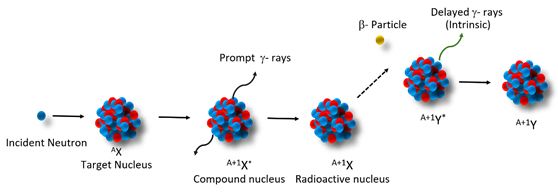
Advantages of Neutron Activation Analysis
Neutron Activation Analysis offers several advantages that make it preferable to many other analytical techniques:
- High sensitivity and accuracy, with detection limits reaching the sub-ppm level for many elements.
- Non-destructive analysis, minimizing sample loss and preserving valuable or rare materials.
- Flexible sample size, suitable for samples ranging from a few milligrams to several hundred milligrams (and in some cases more, depending on the irradiation facility and sample matrix).
- Independence from chemical form, as results are not affected by molecular structure, bonding, or the presence of organic components such as H, O, and C.
- Multi-element capability, allowing simultaneous determination of many elements in a single measurement.
NAA System at the Jordan Research and Training Reactor (JRTR)
The Neutron Activation Analysis (NAA) Division began providing services in 2017, offering analytical support to researchers and clients in fields such as archaeology, mining and geology, environmental studies, nutrition sciences, and related areas.
The division includes three main laboratories:
- Sample Preparation Laboratory
Samples are prepared, weighed, packaged, labeled, and documented according to irradiation and safety requirements.
- Irradiation Laboratory
Samples are irradiated by transferring them to irradiation positions in or near the reactor core using a pneumatic transfer system, as required by the analysis protocol.
- Measurement Laboratory
Gamma-ray emissions are measured using an HPGe detector, followed by spectrum processing and quantitative analysis to determine elemental concentrations.
Staff receive comprehensive training covering the full analytical workflow—from sample preparation and irradiation to gamma-ray spectrometry and data analysis—ensuring accurate and reliable results.
Quality assurance is maintained through the use of certified reference materials and routine quality control checks. The division also participates regularly in international proficiency tests organized by the International Atomic Energy Agency (IAEA) to verify performance and ensure the reliability of reported results.
In recent years, the NAA Division at JRTR has successfully measured concentrations of multiple elements in geological and environmental samples, including soils and plants, as well as rare earth elements (REEs), supporting research and applied projects across several disciplines.
For more information, please contact: NAA@jrtr.gov.jo